
Every week I see patients who have been advised to consider Platelet-Rich Plasma (PRP) injections for long-standing tendon pain.
Many have already spent hundreds—or even thousands—of pounds hoping PRP will be the answer after reading impressive marketing claims online.
Unfortunately, the scientific evidence tells a different story.
If you’re considering PRP for a tendon injury, it’s important to understand what current research actually shows before investing in an expensive treatment.
What is PRP?
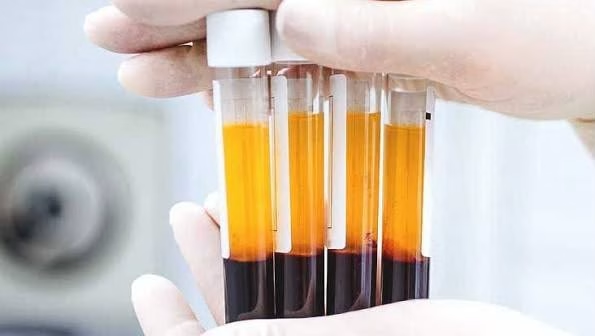
Platelet-Rich Plasma (PRP) is created by taking a sample of your blood, spinning it in a centrifuge and injecting the concentrated platelets back into the injured tendon.
The theory is simple:
- Platelets contain growth factors.
- Growth factors may stimulate healing.
- Healing should reduce pain.
It sounds logical.
Tendon Pain Isn’t Simply “Damage”
One of the biggest misconceptions is that painful tendons simply need “healing.”
In reality, many chronic tendon problems involve:
- failed tendon adaptation
- altered collagen structure
- reduced load tolerance
- nervous system sensitisation
- muscle weakness
- movement dysfunction
Injecting growth factors does not automatically reverse these problems.
The tendon still needs appropriate loading and rehabilitation.
What Does the Research Say?
Large systematic reviews have found that PRP often provides little or no clinically meaningful improvement compared with placebo injections or structured exercise programmes.
For many common tendon conditions including:
- Achilles tendinopathy
- Tennis elbow
- Patellar tendinopathy
- Rotator cuff tendinopathy
The results have been inconsistent. Some studies report small improvements; others show no difference whatsoever.
When researchers combine all the evidence together, PRP has generally failed to demonstrate consistent superiority over well-designed rehabilitation programmes.
Why Are Results So Inconsistent?
One major problem is that there is no standard PRP.
Different clinics use different:
- machines
- platelet concentrations
- white blood cell content
- injection techniques
- treatment protocols
This makes comparing studies extremely difficult.
Two patients paying for “PRP” may actually receive very different products.
The Cost
PRP is rarely available on the NHS for tendon pain because evidence of benefit remains uncertain.
Private treatment often costs between £400–£1,000 per injection, and many clinics recommend multiple injections.
For many patients this represents a significant financial commitment without a guarantee of better outcomes.
What Actually Has Strong Evidence?
The treatments consistently supported by research include:
- Progressive strength training
- Heavy slow resistance exercise
- Load management
- Biomechanical assessment
- Activity modification
- Education
- Addressing weakness throughout the kinetic chain
These interventions improve the tendon’s ability to tolerate load rather than simply attempting to “repair” it.
The Importance of an Accurate Diagnosis
Not all tendon pain is actually tendon pain. Conditions such as bursitis, partial tendon tears, arthritis or referred pain can mimic tendinopathy. This is why diagnostic ultrasound assessment is so valuable.
At LG Physiotherapy Ultrasound Injection Clinic, every treatment plan begins with a thorough clinical examination and, where appropriate, a diagnostic ultrasound scan to confirm the diagnosis before discussing treatment options.
My Approach
As a Consultant Musculoskeletal Physiotherapist, I only recommend treatments where I believe the evidence supports their use.
Rather than offering expensive interventions with uncertain benefits, my focus is on:
- identifying the true cause of pain
- providing an accurate diagnosis
- creating an evidence-based rehabilitation programme
- using ultrasound-guided injections only when clinically appropriate
- helping patients avoid unnecessary procedures
My mission has always been simple:
To help patients recover using treatments supported by the best available evidence while preventing unnecessary interventions whenever possible.
For most patients, an accurate diagnosis, progressive rehabilitation and appropriate loading remain the cornerstone of successful tendon treatment